
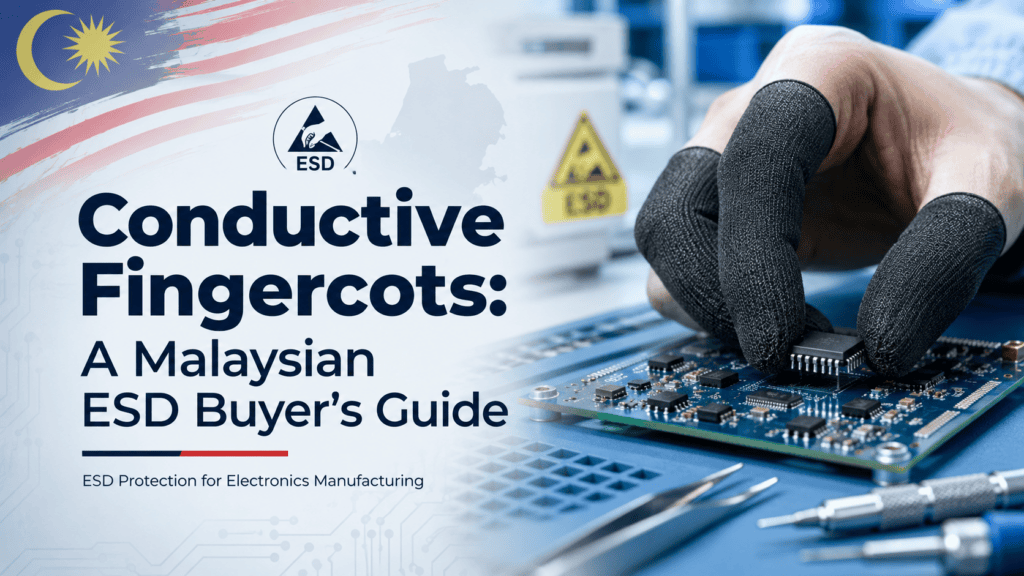
Quick answer: Black conductive fingercots are carbon-loaded nitrile fingertip covers built for ESD-safe precision handling. Under the ANSI/ESD S20.20 and IEC 61340-5-1 convention, “conductive” materials sit below roughly 104–105 ohms surface resistance, while “static dissipative” materials (like standard pink latex ESD fingercots) fall in the 105–1011 ohm range. Both protect components — the right choice depends on what your task is handling.
Why Fingertip-Only Protection Makes Sense for Precision Handling
A full ESD glove protects the whole hand, but it also blunts the tactile feedback an operator needs to seat a fine-pitch connector, place a passive component, or inspect a solder joint by feel. Fingercots solve a narrower problem: they cover the one, two, or three fingers actually doing the work — typically the thumb, index, and middle finger — while leaving the rest of the hand free.
Beyond dexterity, fingercots exist to keep skin off the product. Bare fingers transfer oils, salts, and perspiration onto board surfaces and contacts, which can affect solder wetting on exposed pads and, over time, contribute to corrosion on connector pins. A thin, powder-free barrier at the fingertip addresses both the contamination risk and the static risk in one piece of PPE.
Fingercots aren’t a substitute for a full ESD glove when a task needs broader hand coverage, cut resistance, or chemical resistance — they’re the right tool specifically for short-duration, high-dexterity handling.
Conductive vs. Static Dissipative: What the Color and Material Are Telling You
In ESD control, “conductive” and “static dissipative” aren’t interchangeable marketing terms — they describe two different points on the same resistance scale, and the difference matters for how fast a charge drains off a surface.
- Conductive materials have low resistance and let charge move almost freely. Fingercots in this class are usually nitrile loaded with carbon black, which is what gives them their black color. The added conductive filler pushes surface resistance down into the low range defined by standards such as ANSI/ESD S541 and IEC 61340-5-1.
- Static dissipative materials let charge move away more slowly and in a controlled manner rather than a sudden dump. Natural rubber latex is naturally in this range without any additive, which is why the traditional pink latex ESD fingercot is classed as dissipative rather than conductive.
Both ranges are considered “antistatic” in the sense that neither one lets charge build up indefinitely the way an ordinary insulative glove would. The exact resistance figure for any given fingercot depends on the manufacturer’s formulation, so it’s worth checking the product’s technical data sheet rather than assuming based on color alone — black nitrile is the common convention for conductive-grade fingercots, but “conductive” and “black” aren’t legally synonymous.
Why Nitrile, and Why Powder-Free
Nitrile has become the default material for conductive fingercots for a few practical reasons that matter on a Malaysian assembly line:
- Latex-free. Natural rubber latex carries a known allergy risk for a portion of any workforce, and repeated exposure can increase sensitization over time. Nitrile removes that risk entirely.
- No sulfur outgassing. Natural rubber latex is vulcanized with sulfur compounds, which can slowly outgas and tarnish exposed metal contacts and connector pins in sensitive assemblies. Nitrile doesn’t carry this risk.
- Powder-free by default. Cornstarch powder used in older glove and cot formulations sheds particulate into the air, which is a direct contamination risk on any board or component headed for a cleanroom-grade process. Powder-free nitrile keeps particle counts down.
- Chemical resistance. Nitrile holds up better than latex against the oils, fluxes, and solvents common on an assembly line.
Conductive or Static Dissipative — Which Does the Task Actually Need?
A practical way to decide is to think about what the component’s own ESD sensitivity classification calls for, and how much of a discharge path the task creates:
- Reach for conductive (black nitrile) fingercots for bare die and wafer handling, connector pin work, rework on charged-device-model (CDM) sensitive ICs, and any task inside an ISO Class 5–6 cleanroom environment where the fastest, most predictable charge bleed-off is the priority.
- Reach for static dissipative (latex) fingercots for general PCB assembly, visual inspection, and lighter-duty ISO Class 7–8 tasks where maximum tactile sensitivity is valued and a controlled, slightly slower discharge rate is preferable to the fastest possible one.
When in doubt, match the fingercot’s resistance class to the same tier your facility already specifies for gloves, mats, and flooring in that zone — consistency across all the surfaces a component touches matters more than any single item being the “most conductive” option available.
A Fingercot Alone Doesn’t Complete the Path to Ground
This is the point most easily missed: a conductive or dissipative fingercot bleeds charge off the fingertip surface, but it doesn’t by itself ground the wearer. Charge still needs somewhere to go. In practice, that means fingercots work as part of a system — a grounded wrist strap or a conductive/dissipative flooring-and-footwear combination that completes the circuit back to a common point ground.
The same logic that applies to a full ESD gowning program applies here at the fingertip level: the setup is only as strong as its weakest link. A worker in the correct black conductive fingercots but no wrist strap, standing on ungrounded flooring, still has an open path for static to accumulate on the rest of the body.
Fitting Fingercots Into a Malaysian E&E ESD Control Program
Malaysia’s Occupational Safety and Health Act 1994 places the legal duty on employers to provide a workplace free from recognized hazards, and for electronics and electrical (E&E) manufacturers, an uncontrolled static discharge event is treated as exactly that — a hazard that belongs in the facility’s HIRARC (Hazard Identification, Risk Assessment and Risk Control) documentation, not an informal housekeeping issue.
On the technical side, Malaysian E&E and semiconductor facilities generally build their ESD control programs around the same two international references used globally: ANSI/ESD S20.20 for the overall program structure, and IEC 61340-5-1 for the detailed technical requirements. Resistance testing and verification are typically carried out through SIRIM or other Standards Malaysia–accredited laboratories as part of routine compliance checks.
This matters most concretely in Malaysia’s major E&E clusters — Penang’s Bayan Lepas Free Trade Zone, Kulim Hi-Tech Park in Kedah, and the growing E&E and semiconductor investment corridor in Johor — where high-value, ESD-sensitive components move through assembly and test lines at volume. In that context, fingercots aren’t a stand-alone purchase; they’re the fingertip-level layer of the same gowning and grounding program that includes ESD smocks, gloves, wrist straps, and flooring.
Sizing and Fit
Fingercots are typically sold across a small size range — commonly labeled Small, Medium, and Large, or numbered 0 through 5 depending on the manufacturer — and fit matters more than it might seem. A cot that’s too loose bunches at the tip and reduces tactile control; one that’s too tight restricts circulation over a shift and can tear under repeated flexing. Medium is the size most manufacturers position as the default fit for an average adult finger, which is why it’s usually the highest-volume SKU stocked for general assembly-line use.
Because fingercots are a single-use, high-turnover consumable rather than a durable good, they’re typically packed and sold in bulk (commonly several hundred to a thousand pieces per bag) to match daily disposal rates on an active line.
Full Comparison: Conductive vs. Static Dissipative vs. Standard Fingercots
| Type | Material | Resistance Class | Best For | Latex-Free |
|---|---|---|---|---|
| Black Conductive Fingercots | Carbon-loaded nitrile | Conductive (low resistance) | CDM-sensitive ICs, bare die/wafer handling, ISO 5–6 cleanroom tasks | Yes |
| Pink Static Dissipative Fingercots | Natural rubber latex | Static dissipative (mid resistance) | General PCB assembly, inspection, ISO 7–8 tasks | No |
| Standard Nitrile Fingercots | Nitrile, no ESD additive | Insulative / not ESD-rated | Non-ESD contamination or oil protection only | Yes |
Frequently Asked Questions
Are black conductive fingercots the same as static dissipative fingercots?
No. Both are considered antistatic in the broad sense, but they sit at different points on the resistance scale. Conductive fingercots (typically black, carbon-loaded nitrile) have lower resistance and drain charge faster; static dissipative fingercots (typically pink latex) have higher resistance and drain charge more gradually. Which one a task needs depends on the ESD sensitivity of the component being handled.
Do fingercots replace a full ESD glove or a wrist strap?
No. Fingercots protect the fingertips doing close, high-dexterity work, but they don’t ground the wearer on their own. A grounded wrist strap or a conductive/dissipative flooring-and-footwear system is still needed to give static charge a path to ground; the fingercot is one layer of a larger control program, not a replacement for it.
Can conductive fingercots be reused, or are they single-use?
Most fingercots used in electronics and cleanroom settings are treated as single-use, disposable items, since repeated flexing, contact with skin oils, and general wear degrade both the barrier function and the conductive properties over time. Facilities should follow the specific reuse or replacement guidance on the supplier’s technical data sheet rather than judging visually.
What sizing should a Malaysian assembly line stock?
Medium is generally the highest-volume size for a mixed workforce and is the practical default to stock in bulk, with Small and Large kept on hand to fit workers outside the average range. Poor fit — too loose or too tight — reduces both dexterity and the reliability of the static path, so it’s worth stocking a proper size range rather than one size for everyone.
Do Fingercots need to be tested or certified before use in an ESD control program?
Facilities building a program around ANSI/ESD S20.20 and IEC 61340-5-1 typically verify resistance values as part of routine compliance testing, often through SIRIM or other Standards Malaysia–accredited labs, rather than relying on the supplier’s labeling alone. Ask your supplier for the product’s technical data sheet showing tested surface resistance before specifying it into a qualified process.
Product Image shown:
Black Conductive Fingercots

Biz One Sdn Bhd
8-02-06, Sunny Point Complex, Jalan Batu Uban, 11700 Gelugor, Pulau Pinang, Malaysia
Mobile: +60 14-304 3226 | Office: +60 4-376 8389
Email: sales@wdr.my | sales01@wdr.my