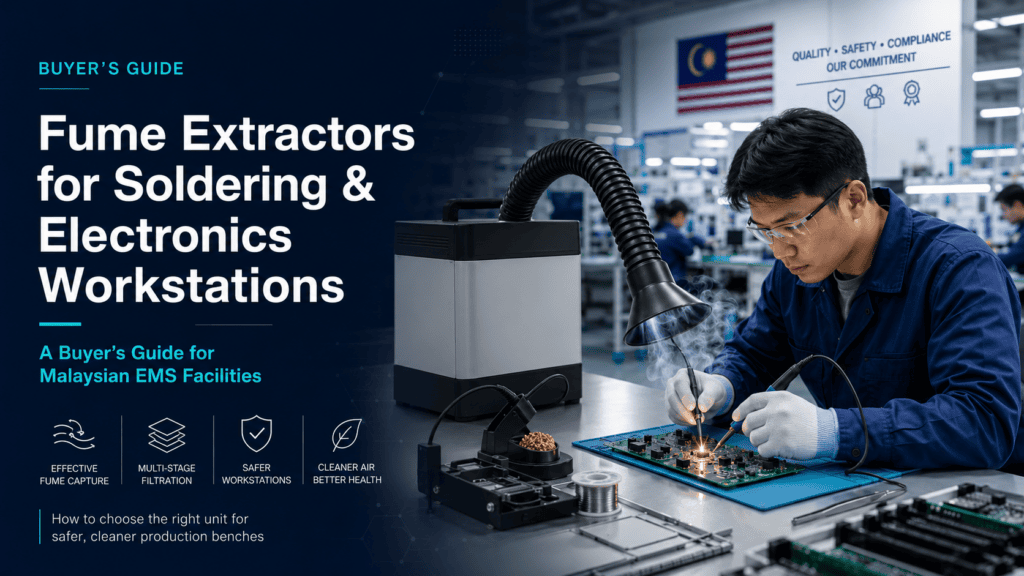
A Buyer’s Guide for Malaysian EMS Facilities
A fume extractor is the one piece of equipment standing between that exposure and the worker breathing it in. This guide walks through why it matters, how the equipment actually works, and what to check before you buy.
Solder fume gets treated as background noise on a lot of production floors — a faint smell, a slight haze over the bench, nothing that stops the line. But rosin-based flux fumes are a documented occupational health hazard, linked to respiratory irritation and occupational asthma with repeated exposure over a shift, a week, a career.
Why Fume Extractors Aren’t Optional at a Soldering Workstation
When solder flux is heated, it releases an aerosol of rosin particles and volatile organic compounds. At low, occasional exposure, this is a minor irritant. At sustained exposure — the kind that happens on an EMS assembly line running full shifts — it’s a recognized contributor to occupational respiratory problems. This is exactly the kind of airborne hazard that a Chemical Health Risk Assessment (CHRA) under Malaysia’s Occupational Safety and Health framework is meant to catch, and it’s why fume extraction sits alongside PPE and ventilation as a standard control measure rather than an optional upgrade.
For facilities and electronics corridor, this isn’t a hypothetical: soldering stations are one of the most common fixed workstations on the floor, which means fume exposure is continuous rather than incidental.
How a Fume Extractor Actually Works
Strip away the branding, and every fume extractor does the same three things:
- Draws air in — a fan pulls contaminated air away from the worker’s breathing zone, ideally through a flexible arm or nozzle positioned close to the actual solder joint
- Filters it — the air passes through one or more filter stages, typically a pre-filter for larger particles and an activated carbon stage for the volatile compounds
- Releases clean air — filtered air is returned to the room (or ducted outside, for larger installations)
The difference between a basic unit and a well-built one comes down to how much air it actually moves, how many filter stages it uses, and how consistently it maintains suction as the filter loads up over time.
How a Fume Extractor Protects Your Health
A fume extractor removes harmful fumes at the source, ensuring the air you breathe is cleaner and safer.
What to Check Before You Buy
| Factor | Why it matters |
|---|---|
| Suction power/fan quality | Weak suction means fumes escape the capture zone before they’re pulled in — a high-quality alloy fan sustains suction better than a basic plastic-bladed fan |
| Filter stages | Single-stage filters clog fast and lose efficiency; a triple-filter design spreads the load across pre-filter, carbon, and fine-particle stages for more consistent purification |
| Noise level | A unit that’s loud enough to bother the operator gets switched off or left further from the work than it should be — noise-reduced design matters as much for actual usage rates as for comfort |
| Build quality | A metal body structure holds up to daily bench use and vibration far better than plastic housings over a multi-year service life |
| Reach and positioning | A flexible arm or adjustable nozzle that reaches the actual joint matters more than raw suction power — extraction only works if it’s positioned close to the fume source |
| ESD compatibility | On an ESD-controlled line, confirm the housing and any grounding points are compatible with your existing ESD control program, rather than assuming any fume extractor is automatically ESD-safe |
| Filter replacement | Ask how the filters are accessed and replaced — a unit that’s difficult to service tends to get neglected, which quietly defeats the purpose |
Biz One’s Fume Extractor Line
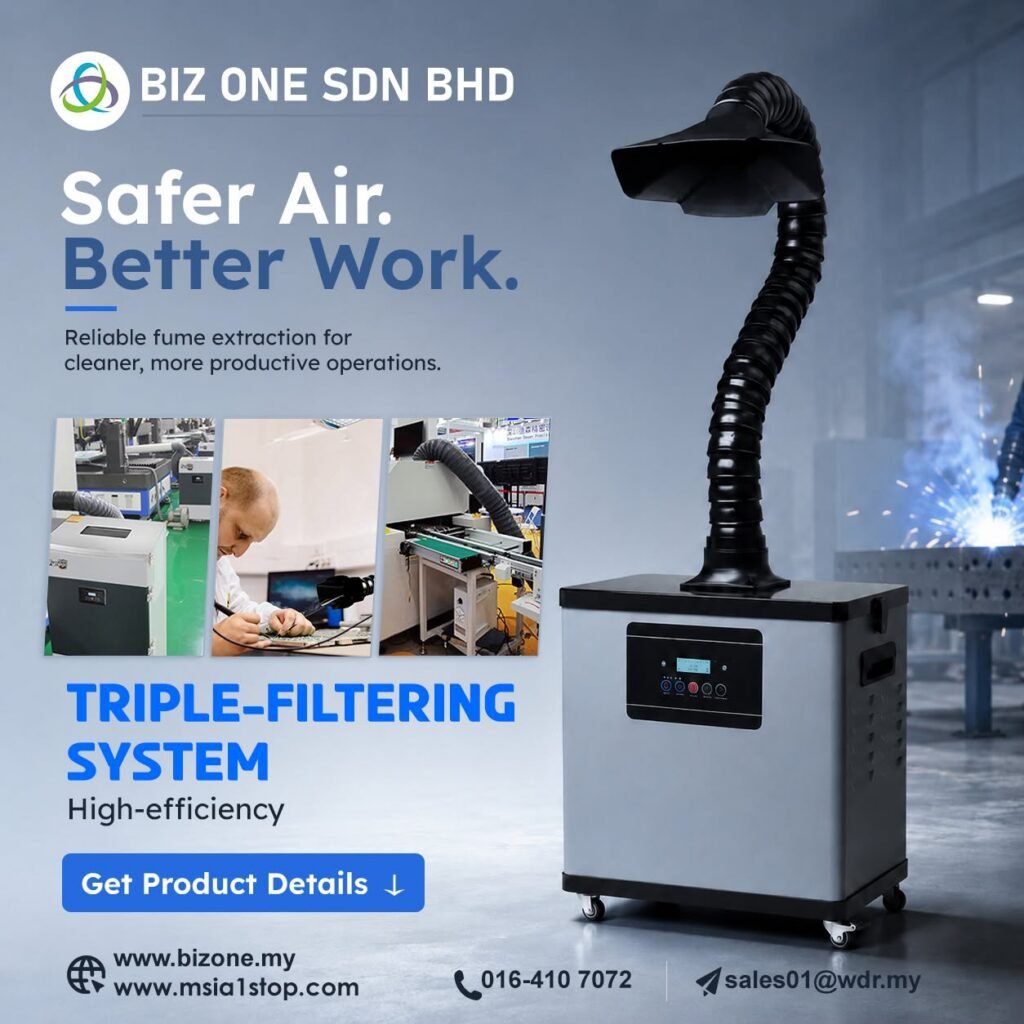
Biz One’s Engineering Products category carries fume extractors alongside soldering accessories and consumables, built around the selection factors above. The F6002 model, for example, is built with a metal body structure for durability, a noise-reduction design aimed at quiet continuous operation, a triple-filter design for more thorough purification across multiple stages, and a high-quality alloy fan for stronger suction. If you’re outfitting or refreshing a soldering line, it’s worth requesting the current spec sheet directly so you can match unit capacity to your bench layout and headcount.
Fume Extractor vs. General Ventilation: Do You Need Both?
General workshop ventilation dilutes contaminated air across the whole room. A fume extractor captures it at the source, before it disperses. For any workstation with sustained daily soldering, source capture is the more effective control — general ventilation alone typically isn’t enough to keep exposure at the source below what a CHRA would flag. Most well-run EMS floors run both: local extraction at each bench, with general ventilation as a secondary layer rather than the primary control.
Where This Fits Into a Complete Workstation
A soldering or electronics assembly bench rarely needs fume extraction alone. It typically sits alongside ESD wrist straps and grounding, an ESD table mat, ESD tweezers for component handling, and — depending on your facility’s gowning protocol — the same entry-control garments covered in our cleanroom gowning checklist. Treating the workstation as one system, rather than sourcing fume extraction separately from everything else on the bench, is usually the more efficient way to specify and order.
Frequently Asked Questions
Do I need a fume extractor if my facility already has general air conditioning and ventilation?
General ventilation dilutes fumes across the room but doesn’t capture them at the source. For any bench with regular, sustained soldering work, source-capture extraction is the more effective control, and is usually what a workplace risk assessment will call for, even where general ventilation is already in place.
Is every fume extractor ESD-safe?
No — ESD compatibility depends on the specific unit’s housing and grounding design. Confirm this directly for any unit you’re considering if it will sit on an ESD-controlled bench, rather than assuming it by default.
How many filter stages should a fume extractor have?
More stages generally mean more consistent purification over the filter’s working life, since the load is spread across a pre-filter, an activated carbon stage, and a fine-particle stage rather than one filter doing everything. A triple-filter design is a reasonable baseline for continuous production use.
What should I have ready before requesting a quote?
The number of workstations needing extraction, your bench layout (fixed line vs. individual stations), whether the line is ESD-controlled, and whether you’re a trader/reseller or an end-use facility.
Next Step
Biz One Sdn Bhd supplies fume extractors and soldering accessories as part of its Engineering Products range, alongside the full ESD/cleanroom, PPE, and cleanroom apparel categories needed to outfit a complete workstation. Get in touch with our team with your workstation count, layout, and whether the line is ESD-controlled, and we’ll help you match the right unit.